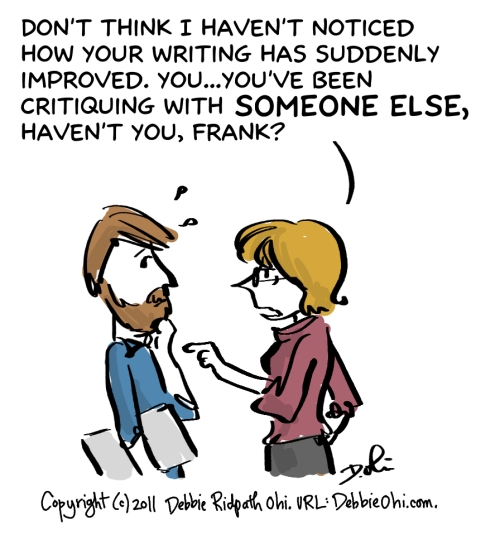
We all have various strengths, and since we're friends now, I thought it would make sense to pool those strengths and all come out better for it! So, I'd like to make a proposal:
As you might have noticed, I'm not in the least graphic design savvy and have used a relatively standard bog template here. It's really not a good fit though, and I'd love to have something more personal. Unfortunately, my knowledge in this particular area is somewhere around zero and it would probably take me a really long time to come up with something that, in the end, will be sub par. So, this is where you come in, my lovely readers :) I happen to know that some of you excel in this area and I'd like to propose a swap of services!
Personally, I'm a pretty good critter (or so I've been told), and I'd like to swap a blog and banner design for either a full Beta read of your finished manuscript, or a 100 page critique, to be redeemed at the time of your choice. Any takers?
And, in case anyone else out there is in need of something writing/reading related which they could use a little help with, propose a swap of your own in the comments :)
Showing posts with label critique. Show all posts
Sunday, June 24, 2012
Tuesday, April 3, 2012
C is for Critique-er
There are so many posts on receiving critique, but what about giving it? Being able to write well doesn't one is automatically able to critique well. So, how do we improve our critiquing skills?
There are many threads on writing forums like Absolute Write and Scribophile where the topic of whether or not it is acceptable to critique the critiquer are discussed. There are many who are strongly against it. They might be afraid that the critique will shift focus from the author's work to other critiques, that things might get personal, or that critiquers will shy away from sharing their honest impressions and opinions. Then, there are some critiquers who do not want to receive feedback - they see it as a waste of time (or maybe they are afraid of having their pride hurt).
But what about those of us who would like to improve our critiquing skills? Personally, I don't see improvement as a waste of time at all. Not only do I hate the idea of wasting my time to provide a critique which isn't useful, I also realize that I am the first line of critique for my own work. The way I see it, improving my critiquing skills can only be beneficial (to me and to my CPs).
There are so many things to think about when giving critique - What kind of critique does the writer want? How do I critique a first draft versus a final draft? Should I be providing feedback on big-picture issues or line-edits? Luckily, there are resources out there for those who want to improve.
So far, the best breakdown of how to give an appropriate critique that I've found is on Janice Hardy's blog.
Otherwise, here are some additional resources I've found helpful:
How to critique a manuscript and stay friends
Checklist for critiquing a novel
The Critter's Library
So what about you? Have you ever received feedback on a critique you've given? Would you want to? And if you agree that it's important to work on critiquing skills, what do you do to improve?
There are so many things to think about when giving critique - What kind of critique does the writer want? How do I critique a first draft versus a final draft? Should I be providing feedback on big-picture issues or line-edits? Luckily, there are resources out there for those who want to improve.
So far, the best breakdown of how to give an appropriate critique that I've found is on Janice Hardy's blog.
Otherwise, here are some additional resources I've found helpful:
How to critique a manuscript and stay friends
Checklist for critiquing a novel
The Critter's Library
So what about you? Have you ever received feedback on a critique you've given? Would you want to? And if you agree that it's important to work on critiquing skills, what do you do to improve?
Monday, March 5, 2012
Turning off the critical eye
Last week I finished a YA book which I really enjoyed (overall). The only problem was, it was plagued by a serious case of unnecessary "that"s. And I noticed. And no, I won't tell you which book it was (although if you are of a mind to know, you could always check my goodreads profile).
Normally, I am able to turn off my critical eye. I still notice gaping plot holes or poor writing with my critical eye off, but those are issues I notice as a reader. It's the nitpicky things I don't like to notice when I read for pleasure - overusage of "that" (or any other word, take "just" for example), a repeated/missing word, a small typo, overly-exotic dialogue tags (she ululated), a point of view slip.
But lately, I've been reading a whole lot of unpublished chapters critically, and my critting mindset is spilling over into my pleasure reading. This isn't always as bad as it sounds - sometimes I purposefully read a book critically, but only when it's a book I loved and I'm reading it for a second time to see how the author did something.
So now I'm thinking I might need a sort of break between critting and pleasure reading in order to really experience the book as a reader and not as a critical writer. Maybe I won't crit at all while I'm reading a book, not until it's done.
Do you have the same issue? How do you deal with it?
| I'm not cool and I know it, Sean Landers |
But lately, I've been reading a whole lot of unpublished chapters critically, and my critting mindset is spilling over into my pleasure reading. This isn't always as bad as it sounds - sometimes I purposefully read a book critically, but only when it's a book I loved and I'm reading it for a second time to see how the author did something.
So now I'm thinking I might need a sort of break between critting and pleasure reading in order to really experience the book as a reader and not as a critical writer. Maybe I won't crit at all while I'm reading a book, not until it's done.
Do you have the same issue? How do you deal with it?
Sunday, February 26, 2012
Weekend Progress Report
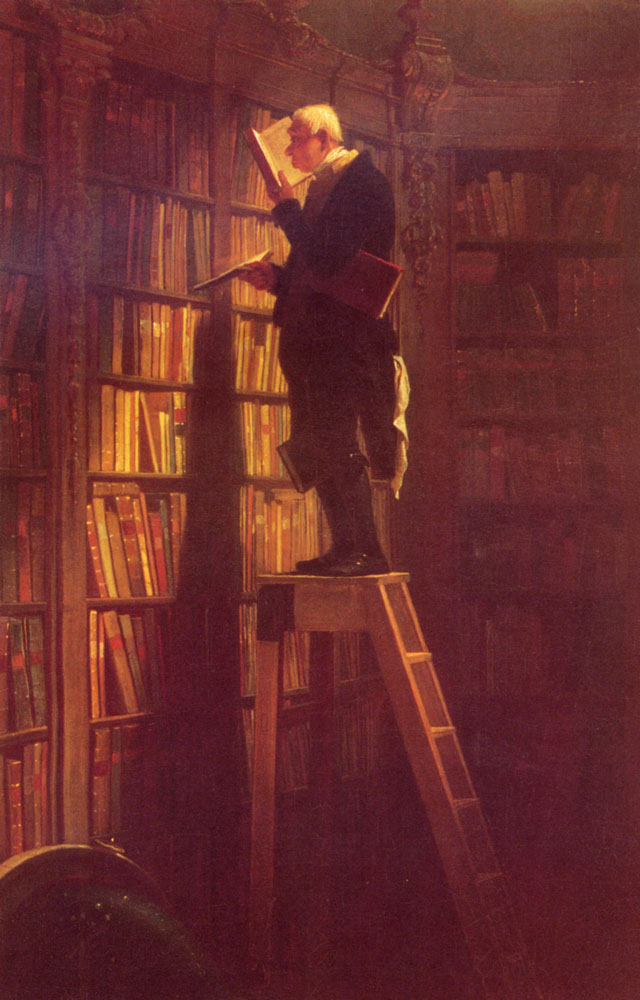
| The Bookworm (Carl Spitzweg) |
I also took another look at the first chapter of DAUGHTER OF THE MOON before sending it off to literary agent Gemma Cooper for the critique I won. I'm really excited to see what she thinks of my story!
And I am still working away at the first draft of the sequel to DAUGHTER OF THE MOON. So far, I'm at 20,608 words and I hope to have significantly increased that number for next weekend's progress report!
20608 / 50000 (41.22%)
Thursday, February 23, 2012
On crits ... and making sense of it all
Critique:
One of the most confounding and yet simultaneously rewarding steps of writing a
manuscript. I love critting - and I love receiving crits of my work!
(especially ones which use words like "love" and
"well-written") But, when it comes time to make sense of the
criticism, things can get tricky. Everyone has an opinion, and those opinions
are seldom unanimous.
Only,
some of the feedback was contradictory and I didn't know which comments I
should toss vs. the comments I should take to heart. I fiddled with my
manuscript, tried to please critter #1 without losing what critter #7 found so
fantastic. And suddenly, I didn't recognize my own work anymore. I tossed the
new revision and let the feedback simmer in the back of my mind until I was
ready for it. And then I realized, some of the feedback didn't have anything to
do with my writing at all. Some of the feedback was more about the reader. I
can't always anticipate, or control the reaction a reader has to my work. All I
can do is remain true to my main character's (MC) voice and perspective.
Here's a
two-line excerpt from DAUGHTER OF THE MOON which generated wildly different
reactions:
Original Text:
The dream
still felt familiar, as they all did, but unlike any others before it, this
dream had left an impression on her soul. Even the air felt heavy with
significance.
Critique #1, #5, #6 and #7: (No
comments from the critter)
Critique #2:
The dream
still felt familiar, as they all did, but unlike any others before it, this
dream had left an impression on her soul. Even the air felt heavy with
significance??
Critique #3:
The dream
still felt familiar, as they all did, but unlike any others before it, this
dream had left an impression on her soul. What does an impression on a
soul feel like? I know we can all resonate with an impression on our minds, but
what makes this feeling different? Even the air felt heavy
with significance.
Critique
#4:
It still felt
familiar, as they all did, but unlike any others before it, this dream had left
an impression on her soul (would she
know it was her soul?), somewhere deep within. Even the air felt
heavy with significance the lingering
scent of mist, and something else, like charred matter (or something, you get
my drift, I think 'significance' lacks significance here).
Critique
#8
The dream still felt
familiar, as they all did, but unlike any others before it, this dream had left
an impression on her soul. (I think I can imagine
what that feels like, though it does sound a bit cliched and melodramatic.)Even
the air felt heavy with significance. (Similar to Poe's
"The Raven": "Then methought, the air grew denser, perfumed
from an unseen censer"...nice allusion...)
Critique
#9:
The dream still
felt familiar, as they all did, but unlike any others before it,
this dream had left an impression on
her soul. The wording here needs to be altered. Some people would scoff
at the idea that 'one dream' could leave an impression on someone's soul. Even the
air felt heavy with significance.
Nearly half of those
who commented didn't seem to think it was possible for an experience to leave
an impression on the soul. One didn't seem to think it was impossible, and the
rest didn't mention anything about these two sentences. Personally, I don't
know what I think about the human soul - but I know how my MC sees the matter.
So I left the sentence alone.
Subscribe to:
Posts (Atom)